
 English
 简体中文
简体中文
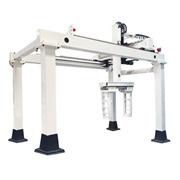
The truss manipulator is a fully automatic industrial equipment, built on the basis of a right angle X, Y, Z coordinate system, mainly used for adjusting the workstation of workpieces or realizing the trajectory motion of workpieces. Its control core is implemented through industrial controllers such as PLC, motion control, microcontroller, etc. By analyzing and processing various input signals (such as sensors, buttons, etc.), the industrial controller makes certain logical judgments and issues execution commands to various output components (relays, motor drivers, indicator lights, etc.) to complete the joint operation between the X, Y, and Z axes, thus achieving a complete set of fully automatic operation processes.
The truss manipulator is mainly composed of six parts: structural frame, X-axis components, Y-axis components, Z-axis components, fixtures, and control cabinet. Among them, the structural framework is composed of structural components such as columns, which serve to elevate each axis to a certain height. It is mostly composed of welded components such as aluminum profiles, square tubes, rectangular tubes, and circular tubes. The X-axis component, Y-axis component, and Z-axis component are the core components of the truss manipulator, following the rules of Cartesian coordinate system definition. Each axis component usually consists of five parts: structural components, guide components, transmission components, sensor detection components, and mechanical limit components.
Fixtures and jigs come in different forms depending on the shape, size, and material of the workpiece, such as vacuum suction cup suction, chuck clamping, support, or needle type fixture insertion. The control cabinet is equivalent to the brain of the truss manipulator, which collects input signals from various sensors or buttons through an industrial controller to send instructions to the executing components to execute predetermined actions.
The truss manipulator is mainly composed of six parts: structural frame, X-axis components, Y-axis components, Z-axis components, fixtures, and control cabinet. Among them, the structural framework is composed of structural components such as columns, which serve to elevate each axis to a certain height. It is mostly composed of welded components such as aluminum profiles, square tubes, rectangular tubes, and circular tubes. The X-axis component, Y-axis component, and Z-axis component are the core components of the truss manipulator, following the rules of Cartesian coordinate system definition. Each axis component usually consists of five parts: structural components, guide components, transmission components, sensor detection components, and mechanical limit components.
Fixtures and jigs come in different forms depending on the shape, size, and material of the workpiece, such as vacuum suction cup suction, chuck clamping, support, or needle type fixture insertion. The control cabinet is equivalent to the brain of the truss manipulator, which collects input signals from various sensors or buttons through an industrial controller to send instructions to the executing components to execute predetermined actions.


