
 English
 简体中文

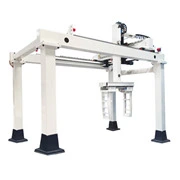
A truss robot (also known as a Cartesian coordinate robot or gantry robot) is an automated device designed based on a Cartesian coordinate system, which achieves precise linear motion through modular structures (such as X, Y, Z axes) and is widely used in the field of industrial manufacturing. Its core functions and advantages are as follows:
1. Precise positioning and handling
1. Precise positioning and handling
- Three dimensional spatial motion: Through the combination of X, Y, and Z axes, precise positioning of workpieces in plane or three-dimensional space can be achieved, with a repeat positioning accuracy of ± 0.05mm or even higher.
- Multi station handling: It can handle materials across multiple stations or equipment, such as picking up materials from machining centers, placing them on inspection stations or packaging lines, reducing manual intervention.
2. Automated loading and unloading
- Machine tool integration: It is linked with CNC machine tools, stamping machines and other equipment to automatically complete workpiece clamping, loading and unloading, and improve processing efficiency (such as 24-hour continuous operation).
- Flexible production: By changing fixtures or adjusting programs, it can quickly adapt to different specifications of workpieces and support small batch and multi variety production modes.
3. Assembly and assembly
- Precision assembly: In industries such as electronics and automotive, precision operations such as screw tightening and component insertion are completed to ensure assembly consistency.
- Multi axis collaboration: Some truss robots are equipped with rotating axes (such as the R axis) to achieve more complex assembly actions (such as flipping and rotating workpieces).
4. Detection and sorting
- Visual guidance: After integrating the visual system, it can identify defects, size or positional deviations in workpieces, and automatically sort qualified and defective products.
- Data traceability: By scanning codes or using RFID technology to record workpiece information, the production process can be traced.
5. Warehousing and Logistics
- Automated warehousing: Complete the storage and stacking of goods in a three-dimensional warehouse, optimizing space utilization.
- AGV Collaboration: Collaborate with Automated Guided Vehicles (AGVs) to achieve cross regional material transportation and build a flexible logistics system.


